
STAFF WRITER
AT around 3AM, three young siblings are awakened by loud voices outside.
As they stretch their arms from the slumber, a group of women is heard calling over from the streets, alerting neighbours that water is now available on the taps.
The eldest is a 10-year-old girl doing her fourth grade at Mahlathini Primary School in the sprawling suburb of Cowdray Park.
It had been six days without the precious liquid in the area. Such is the situation in most residential areas in Bulawayo. The city has for some years been hit by an acute shortage of water, with some of its supply dams being decommissioned.
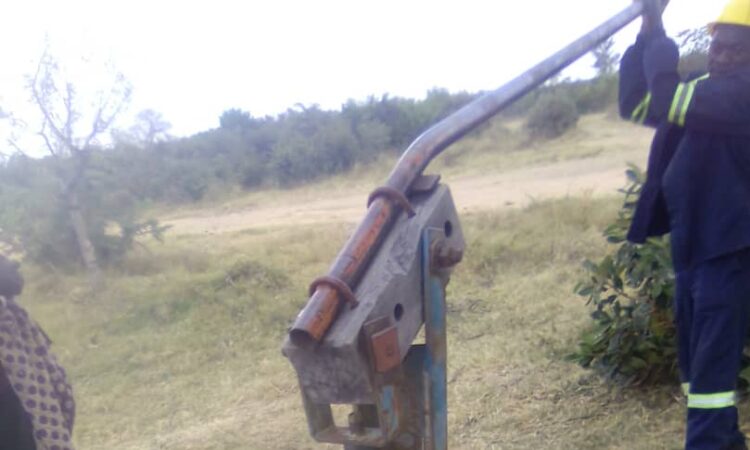
The city council publishes a water provision time table but it does not follow it. Residents do not know when water would be available. They just keep the taps open, for at times it comes at night or early morning. As a result, the only reliable source is the community borehole.
For the girl, if the taps are dry, she has to accompany her mother up the road, 4KM from home, to the borehole. Oftentimes, they find a snaking queue and spend half the day there.
Every day, this is the norm, before she attends classes at Mahlathini Primary School.
While the 10-year-old cannot take up heavy containers, she is fond of carrying a two liter bottle, just for her to have her own water to take home.
In the midst of this, she is aware of the importance of water to her hygiene. At the start of the year, she began her menstrual stage. The young girl now has to be smarter and cleaner, as she is now menstruating.
In the morning of water availability, she was on her periods. As her brothers fill up the containers, she first rushes to the toilet to sort herself up.
It has not been easy for her. Her mother sewed her a sanitary pad, off a piece of clothing. She cannot afford to buy both of them every month. That sanitary pad has to be washed. Without water for six days while she is in her period, she goes through a traumatic situation.
Her mother, Ms Nobuhle Ncube, said they have to rely on two 20 litre containers of water in order to maintain some semblance of hygiene.
My little girl started menstruating in January, at the height of water shedding, said Ms Ncube.
“She finds it hard to keep herself clean when the time comes. I have to monitor her and keep asking if she is on periods yet. It is a struggle but I am glad she is fast getting to understand her situation.
“What is difficult for her, is that water is scarce here. I have a few containers we fill up and share with my three children. Normally, when one is menstruating, they have to bath several times. So when my daughter and I hit the time, the situation was bad. We just use a cup of water each to clean up now and then,” she said.
Ms Ncube is worried her daughter will grow up with not much confidence owing to what she goes through in her menstrual cycle. She recalls a day when she returned from school early, citing she had begun her periods and she could wash up because the school had no water.
“Schools also do not have reliable access to water when the council puts out its water shedding programme. The toilets are at times closed, so our children have containers with water for drinking. If the water bowser is not supplied, girls on menstruation suffer.
“She came running and was so tearful. Her uniform was stained below. When I asked why she cried, she said her classmates laughed at her because she was smelly. She did not attend class for a week.”
There is a noticeable trend of school absenteeism by young girls on menstruation at schools located in high density suburbs.
On the other side of town, in Makokoba township, two 12-year-old girls from Lobengula Primary School fetch water from a community borehole dug by a Non-Governmental Organisation. Both started menstruating in 2021.
They have a sad tale of their experience.
“I live with 7 members of my family. We share water from five 20 litre containers. In just three days, the water runs out and we have to fetch from the borehole.
“I fail to bath properly when I am in my menstruation period. The best I do is to wipe off the flow and spray perfume to ward off the smell,” said one of the girls.
The other young girl revealed that whenever she is menstruating, she goes to her aunt’s apartment in the central business district. It means during that time she does not attend school.“Sihlala sibanengi, we are many at our two roomed house. It is unbearable when there is no water. If I am on periods, I stay with my aunt in town. I do this so that I don’t face a struggle to clean myself up,” she said.
A teacher at primary school in Cowdray Park who cannot be named as she is not allowed to speak to the media said the water crisis has seen a lot of young girls missing out on education.
“Children are opting not to come to school on the days they will be on their menstrual cycle because they have no water to bath and clean themselves up. It makes them lose confidence. They can’t interact with other children and obviously they will be feeling dirty. So we are simply asking for any possible help to ease the water crisis in the city so that our children do not miss out on crucial stages of their education,” she said.
However, Bulawayo Provincial Education director Mr Bernard Mazambane said they were concerned over the issue and have since engaged the city council to avert the situation.
“We cannot have our children absconding school because they are menstruating. As a matter of fact, we are in constant talk with the council to help ease the shortage of water in our school. Only the best solution is to provide bowsers and tanks to the schools, said Mr Mazambane.
“Parents are also advised to be vigilant and offer advice to the girls. The Ministry strongly advises schools to offer psycho-social support to young girls starting their menstruation.”
The young girls’ experience with lack of access to potable water presents a situation where they have to be on menstrual hygiene. Owing to this, not much is documented on the best solution to avert the issue.
Girls on their sexual debut are particularly affected by the lack of safe and accessible water, sanitation and hygiene (WASH).
Mr Peter Maponga, an advocate for hygiene with a Community Based Organisation said girls on their menstrual debut in Bulawayo, carry the burden of spending more time at boreholes, which heavily affects their school performance and ultimately strips their confidence.
“The city council has to act on this, otherwise a lot of these girls will drop out of school. Time spent fetching water is the time they must be studying, he said.
He points out the solution to this is for parents and other stakeholders in schools, to put pressure on the Government to abide by the United Nations Sustainable Goal number 6 which emphasizes on women and girls to be provided with adequate and equitable sanitation and hygiene.
Pumula councilor and the Bulawayo City Council Future Water Supplies and Action Committee chair Skhululekile Moyo admitted that the water crisis was causing inconveniences to the young girl child.
“It’s a fact that girls now go into menstruation early unlike before maybe due to change in lifestyles. As BCC, like in ward 17 we are trying to fix all boreholes that are not working with the help of Africa Ahead. We have other partners who have been offering help like water kiosks. These are some of the measures that council is taking to ensure that the young girls who are in their menstrual debut don’t suffer a lot owing to water shortages,” Moyo said.
However, as the day draws to an end, Ms Ncube gathers containers as they make way to the borehole again. This time her daughter is not joining her, as she is sick and is on menstruation.
The girl will wait for her mother to return, so she can get a bath.