


THE WHO says an independent panel is to assess global responses to the COVID-19 pandemic. This comes as the number of cases worldwide approaches 12 million. Follow DW for the latest.
- WHO sets up independent review panel
- Nearly 5 million people under renewed lockdown in Melbourne, Australia
- Coronavirus cases in the US reach 3 million amid world record daily increase
- More than 12 million COVID-19 cases and over 552,000 deaths worldwide
All updates in Universal Coordinated Time (UTC/GMT)
23:59 We have now closed this live updates article. For the latest developments, see: Coronavirus latest — UN says Latin America and Caribbean are a ‘hot spot’
23:45 Venezuela’s socialist party chief Diosdado Cabello, considered the second-most powerful person in the country after President Nicolas Maduro, has said he tested positive for COVID-19.
He is the highest-ranking figure in Venezuela to become infected with the virus.
Cabello said on Twitter that he is isolating and getting treatment. ”We will win!” he wrote, pledging to recover soon from the illness.
He was last seen publicly on Tuesday when he met with South Africa’s ambassador, Joseph Nkosi. In photographs released by the government, Cabello is seen standing alongside and bumping fists with the envoy while wearing a black mask.
Venezuela is considered one of the world’s least prepared countries to confront the pandemic, with a poor healthcare infrastructure where hospitals are routinely short on basic supplies like water, electricity, and medicine.
Officials had reported 8,010 confirmed cases and 75 deaths from the virus so far and the country has been on an ongoing lockdown for nearly four months.
23:30 South Africa has announced its highest daily number of confirmed coronavirus cases with 13,674 new infections.
The country – Africa’s most developed nation – is now a hot spot in the global pandemic with 238,339 total confirmed cases.
Gauteng province, which includes Johannesburg and the capital, Pretoria, has more than a third of the total cases.
Health Minister Zweli Mkhize has said South Africa could run out of available hospital beds within the month.
23:20 Italian researchers said a study of 31 women with COVID-19 who delivered babies in March and April, found signs of the virus in several samples of umbilical cord blood, the placenta and, in one case, breast milk.
The small study adds to some of the evidence indicating that a pregnant woman infected with the coronavirus might be able to spread it to her fetus.
Nonetheless, Dr. Claudio Fenizia, an immunology specialist at the University of Milan, who leads the study, said it is still ”too early to make guidelines” or to change care towards pregnant women during the pandemic. But Fenzia believes the study is still useful and more attention should be paid to the subject.
So far, doctors have been trying to determine whether in-the-womb infection of COVID-19 could occur, as it does with other viruses such as HIV and Zika.
Several early reports from China point in this direction, although doctors have not been able to ascertain if those women spread the virus to their babies during or after birth.
22:45 Jeanine Añez Chávez, the President of Bolivia, said on Friday that she had tested positive for COVID-19.
In a tweet, she said that she plans to stay in isolation for 14 days, after which she will get tested again. Chávez said that she would continue working from isolation. Her positive result comes at a time when Bolivia’s hospitals are overwhelmed by demand and struggling to admit COVID-19 patients. Bolivia currently has 42,984 cases.
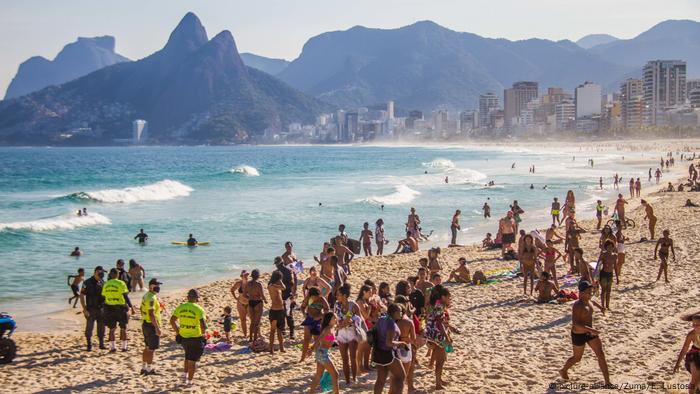
21:25 The famous beaches of Brazil’s Rio de Janeiro will only officially reopen for sunbathing and swimming only once there is a vaccine, according to mayor Marcelo Crivella.
However, many of the beaches are open for exercise and water sports, and beachgoers have regularly broken the rules without using masks or following social distancing guidelines.
“Where you can’t use masks, the inclination is to only return when there is a vaccine, which is being tested, or when contamination is close to zero,” said Crivella.
Brazil is the second-worst hit country by the pandemic after the United States, with more than 1.6 million cases of the disease. The state of Rio de Janeiro has seen nearly 11,000 people die from the illness, the second-worst affected state in Brazil.
20:00 The first case of coronavirus was recorded in northwest Syria, opposition health officials said.
The case revived fears of disaster if the pandemic reached the rebel-held Idlib province’s displacement camps.
“We regret today to announce the first case of coronavirus in a health worker at one of the hospitals [in Idlib],” said opposition health official Maram al-Sheikh.
The patient was a male Syrian doctor in his 30s who had been working in a hospital in the town of Bab al-Hawa on the Syrian-Turkish border, according to Mahmoud Daher, the head of the World Health Organization’s office in Turkey’s Gaziantemp.
“There have been no cases so far in northwest Syria until this morning,” he said. Aid groups have been preparing for an outbreak in the region, which is home to around 3 million people, many of whom live in cramped conditions in displacement camps.
Syria has recorded 372 cases of coronavirus, and a death toll of 14 in government-held areas, while the United Nations has recorded six cases and one death in the Kurdish-controlled northeast.
18:45 Italy closed its borders to travelers from 13 countries that it deemed to be high risk.
Those affected are Armenia, Bahrain, Bangladesh, Brazil, Bosnia-Herzegovina, Chile, Kuwait, Northern Macedonia, Moldova, Oman, Panama, Peru and the Dominican Republic, the Health Ministry said.
“Globally, the pandemic is in its most acute phase. We cannot jeopardize the sacrifices made by Italians in these months. This is why we have chosen the path of utmost caution,” Health Minister Roberto Speranza said.
People who have stayed in or transited through those countries will be blocked at the border, while Italy will suspend direct and indirect flight connections to the specified nations.
Additionally, Italy has been dealing with a new spike in cases this week, linked to arrivals from Bangladesh, which on Tuesday led the ministry to ban incoming flights from the country.
Italy was one of the hardest-hit countries in Europe, with a death toll of nearly 35,000.
18:00 A dozen countries including the United States, Britain and Singapore agreed to ramp up efforts to get some 200,000 stranded merchant sailors home. Crew switches have been on hold amid the pandemic.
Due to travel restrictions, many sailors have been at sea for longer than the 11-month limit prescribed by a maritime labor convention.
Shipping industry officials have said that many sailors are at a breaking point, in a situation that the United Nations has dubbed a “humanitarian crisis,” while other organizations have warned of an increase in suicides.
The signatories to the agreement to open foreign borders to seafarers and boost repatriation efforts include Britain, Denmark, Germany, Greece, Indonesia, the Netherlands, Norway, the Philippines, Saudi Arabia, Singapore, the United Arab Emirates and the United States. The countries also agreed to designate seafarers as “key workers.”
Guy Platten, Secretary-General of the International Chamber of Shipping association, said the countries that made the agreement to open their borders must now act on their commitments.
“Governments must now use this summit as a catalyst to implement the solutions the shipping industry has provided, applying the political will needed to put them into practice,” said Platten.
15:10 The Africa Centers for Disease Control and Prevention chief said the pandemic was reaching “full speed” on the continent.
There are more than 500,000 confirmed cases in Africa, with that tally dominated by South Africa’s roughly 224,000. About 12,000 people are known to have died.
Africa CDC chief John Nkengasong called for wearing masks more often, saying it would save lives and the economy.
“This battle will be won or lost at the community level,” said Nkengasong during a news briefing from Addis Ababa.
He also called for more testing, complaining that just 5.7 million tests had been conducted for a continent with a population of 1.3 billion.
14:00 Bulgaria has reintroduced restrictions on movement after a spike in cases.
Health minister Kiril Ananiev ordered nightclubs and bars to close their indoor spaces again starting on Friday, while the outdoor areas would be allowed to remain open at 50% capacity. Soccer matches and other sporting events will have to take place behind closed doors. Weddings and other festivities could be attended by up to 30 people, but under strict social distancing rules.
There were more than 6,300 reported cases in the country as of Thursday, compared to about 2,700 last month in the country of nearly 7 million people.
12:50 Indonesia reported its biggest daily rise in infections, following an outbreak at a military training center in West Java.
Nearly half of the 2,567 new cases were linked to the outbreak. Health ministry official Achmad Yurianto told reporters that a significant new cluster had emerged at the center, where 1,262 cadets tested positive for the virus.
“We implore the people to stay calm, not panic, because it’s being taken care of professionally according to international standards,” he said.
Over 13,000 people showing acute symptoms were also under close medical observation, but had yet to be tested, while another 38,498 were being monitored for having come in contact with the virus, said Yurianto.
The world’s fourth most populous country, with nearly 268 million residents, has recorded just 70,736 cases and over 3,400 deaths since the start of the pandemic. The health ministry also reported 58 new deaths on Thursday.
However, experts have suggested that the actual number of cases and death toll could be much higher, although the government denies this.
Partial data for 20 of Indonesia’s 35 provinces, gathered from local governments’ websites, showed that there were a further 6,847 deaths of people who had not been tested but displayed severe symptoms. Untested patients are not counted in the official coronavirus death toll in Indonesia.
12:25 The World Health Organization (WHO) said on Thursday it was setting up an independent panel to examine both its own and world governments’ response to the COVID-19 pandemic.
The panel will be headed by former Liberian President Ellen Johnson Sirleaf and former New Zealand Prime Minister Helen Clark, who will both also choose its members, WHO Director-General Tedros Adhanom Ghebreyesus told a virtual meeting with representatives of WHO’s 194 member states.
“This is a time for self-reflection,” Tedros said, adding that “Through you, the world will understand the truth of what happened and also the solutions to build our future better as one humanity.”
The WHO itself has come under criticism for its handing of the crisis, notably from the US. WHO member states had also called unanimously for a review of the global response to the pandemic in May, Tedros said.
11:40 Pakistan is set to open its educational institutions from September 15, the government has announced, as the number of infections steadily declines.
Students would return to schools, colleges and universities if the current downward trend in cases continued, Education Minister Shafqat Mahmood said.
Students and teachers would have to follow strict “standard operating procedures to curtail the virus at campuses,” the minister told reporters at a briefing in Islamabad.
Pakistan ordered a nationwide lockdown in March and shut all of its educational institutions. Plans to hold classes online failed to substantially materialize due to a lack of internet in the country’s conflict zones.https://imasdk.googleapis.com/js/core/bridge3.432.0_en.html#goog_878152390 Watch video03:10
How Pakistan-administered Kashmir managed to contain the coronavirus
09:15 Some 5 million people in Australia’s second-largest city, Melbourne, went into new coronavirus lockdown on Thursday, just weeks after a first set of restrictions ended.
Residents in the metropolitan region are now allowed to leave the house only for work, outside sport, going to the doctor and to buy essential groceries. Schools have once more been closed.
The new restrictions were imposed after authorities in the state of Victoria, where Melbourne is situated, reported 191 new cases of the coronavirus between Monday and Tuesday, the biggest spike there since the pandemic began. Nine inner-city public housing towers in Melbourne were put under separate lockdown in recent days after a cluster of cases was discovered.
Ahead of the lockdown, supermarket shelves were stripped bare of many essential items. The largest supermarket chain says it has put buying limits on items such as pasta, vegetables and sugar.
So far some 9,000 cases of infection have been confirmed in the country, with 106 people dying of COVID-19, the disease caused by the novel coronavirus.
pandemic. This comes as the number of cases worldwide approaches 12 million. Follow DW for the latest.
- WHO sets up independent review panel
- Nearly 5 million people under renewed lockdown in Melbourne, Australia
- Coronavirus cases in the US reach 3 million amid world record daily increase
- More than 12 million COVID-19 cases and over 552,000 deaths worldwide
All updates in Universal Coordinated Time (UTC/GMT)
23:59 We have now closed this live updates article. For the latest developments, see: Coronavirus latest — UN says Latin America and Caribbean are a ‘hot spot’
23:45 Venezuela’s socialist party chief Diosdado Cabello, considered the second-most powerful person in the country after President Nicolas Maduro, has said he tested positive for COVID-19.
He is the highest-ranking figure in Venezuela to become infected with the virus.
Cabello said on Twitter that he is isolating and getting treatment. ”We will win!” he wrote, pledging to recover soon from the illness.
He was last seen publicly on Tuesday when he met with South Africa’s ambassador, Joseph Nkosi. In photographs released by the government, Cabello is seen standing alongside and bumping fists with the envoy while wearing a black mask.
Venezuela is considered one of the world’s least prepared countries to confront the pandemic, with a poor healthcare infrastructure where hospitals are routinely short on basic supplies like water, electricity, and medicine.
Officials had reported 8,010 confirmed cases and 75 deaths from the virus so far and the country has been on an ongoing lockdown for nearly four months.
23:30 South Africa has announced its highest daily number of confirmed coronavirus cases with 13,674 new infections.
The country – Africa’s most developed nation – is now a hot spot in the global pandemic with 238,339 total confirmed cases.
Gauteng province, which includes Johannesburg and the capital, Pretoria, has more than a third of the total cases.
Health Minister Zweli Mkhize has said South Africa could run out of available hospital beds within the month.
23:20 Italian researchers said a study of 31 women with COVID-19 who delivered babies in March and April, found signs of the virus in several samples of umbilical cord blood, the placenta and, in one case, breast milk.
The small study adds to some of the evidence indicating that a pregnant woman infected with the coronavirus might be able to spread it to her fetus.
Nonetheless, Dr. Claudio Fenizia, an immunology specialist at the University of Milan, who leads the study, said it is still ”too early to make guidelines” or to change care towards pregnant women during the pandemic. But Fenzia believes the study is still useful and more attention should be paid to the subject.
So far, doctors have been trying to determine whether in-the-womb infection of COVID-19 could occur, as it does with other viruses such as HIV and Zika.
Several early reports from China point in this direction, although doctors have not been able to ascertain if those women spread the virus to their babies during or after birth.
22:45 Jeanine Añez Chávez, the President of Bolivia, said on Friday that she had tested positive for COVID-19.
In a tweet, she said that she plans to stay in isolation for 14 days, after which she will get tested again. Chávez said that she would continue working from isolation. Her positive result comes at a time when Bolivia’s hospitals are overwhelmed by demand and struggling to admit COVID-19 patients. Bolivia currently has 42,984 cases.
21:25 The famous beaches of Brazil’s Rio de Janeiro will only officially reopen for sunbathing and swimming only once there is a vaccine, according to mayor Marcelo Crivella.
However, many of the beaches are open for exercise and water sports, and beachgoers have regularly broken the rules without using masks or following social distancing guidelines.
“Where you can’t use masks, the inclination is to only return when there is a vaccine, which is being tested, or when contamination is close to zero,” said Crivella.
Brazil is the second-worst hit country by the pandemic after the United States, with more than 1.6 million cases of the disease. The state of Rio de Janeiro has seen nearly 11,000 people die from the illness, the second-worst affected state in Brazil.
20:00 The first case of coronavirus was recorded in northwest Syria, opposition health officials said.
The case revived fears of disaster if the pandemic reached the rebel-held Idlib province’s displacement camps.
“We regret today to announce the first case of coronavirus in a health worker at one of the hospitals [in Idlib],” said opposition health official Maram al-Sheikh.
The patient was a male Syrian doctor in his 30s who had been working in a hospital in the town of Bab al-Hawa on the Syrian-Turkish border, according to Mahmoud Daher, the head of the World Health Organization’s office in Turkey’s Gaziantemp.
“There have been no cases so far in northwest Syria until this morning,” he said. Aid groups have been preparing for an outbreak in the region, which is home to around 3 million people, many of whom live in cramped conditions in displacement camps.
Syria has recorded 372 cases of coronavirus, and a death toll of 14 in government-held areas, while the United Nations has recorded six cases and one death in the Kurdish-controlled northeast.
18:45 Italy closed its borders to travelers from 13 countries that it deemed to be high risk.
Those affected are Armenia, Bahrain, Bangladesh, Brazil, Bosnia-Herzegovina, Chile, Kuwait, Northern Macedonia, Moldova, Oman, Panama, Peru and the Dominican Republic, the Health Ministry said.
“Globally, the pandemic is in its most acute phase. We cannot jeopardize the sacrifices made by Italians in these months. This is why we have chosen the path of utmost caution,” Health Minister Roberto Speranza said.
People who have stayed in or transited through those countries will be blocked at the border, while Italy will suspend direct and indirect flight connections to the specified nations.
Additionally, Italy has been dealing with a new spike in cases this week, linked to arrivals from Bangladesh, which on Tuesday led the ministry to ban incoming flights from the country.
Italy was one of the hardest-hit countries in Europe, with a death toll of nearly 35,000.
18:00 A dozen countries including the United States, Britain and Singapore agreed to ramp up efforts to get some 200,000 stranded merchant sailors home. Crew switches have been on hold amid the pandemic.
Due to travel restrictions, many sailors have been at sea for longer than the 11-month limit prescribed by a maritime labor convention.
Shipping industry officials have said that many sailors are at a breaking point, in a situation that the United Nations has dubbed a “humanitarian crisis,” while other organizations have warned of an increase in suicides.
The signatories to the agreement to open foreign borders to seafarers and boost repatriation efforts include Britain, Denmark, Germany, Greece, Indonesia, the Netherlands, Norway, the Philippines, Saudi Arabia, Singapore, the United Arab Emirates and the United States. The countries also agreed to designate seafarers as “key workers.”
Guy Platten, Secretary-General of the International Chamber of Shipping association, said the countries that made the agreement to open their borders must now act on their commitments.
“Governments must now use this summit as a catalyst to implement the solutions the shipping industry has provided, applying the political will needed to put them into practice,” said Platten.
15:10 The Africa Centers for Disease Control and Prevention chief said the pandemic was reaching “full speed” on the continent.
There are more than 500,000 confirmed cases in Africa, with that tally dominated by South Africa’s roughly 224,000. About 12,000 people are known to have died.
Africa CDC chief John Nkengasong called for wearing masks more often, saying it would save lives and the economy.
“This battle will be won or lost at the community level,” said Nkengasong during a news briefing from Addis Ababa.
He also called for more testing, complaining that just 5.7 million tests had been conducted for a continent with a population of 1.3 billion.
14:00 Bulgaria has reintroduced restrictions on movement after a spike in cases.
Health minister Kiril Ananiev ordered nightclubs and bars to close their indoor spaces again starting on Friday, while the outdoor areas would be allowed to remain open at 50% capacity. Soccer matches and other sporting events will have to take place behind closed doors. Weddings and other festivities could be attended by up to 30 people, but under strict social distancing rules.
There were more than 6,300 reported cases in the country as of Thursday, compared to about 2,700 last month in the country of nearly 7 million people.
12:50 Indonesia reported its biggest daily rise in infections, following an outbreak at a military training center in West Java.
Nearly half of the 2,567 new cases were linked to the outbreak. Health ministry official Achmad Yurianto told reporters that a significant new cluster had emerged at the center, where 1,262 cadets tested positive for the virus.
“We implore the people to stay calm, not panic, because it’s being taken care of professionally according to international standards,” he said.
Over 13,000 people showing acute symptoms were also under close medical observation, but had yet to be tested, while another 38,498 were being monitored for having come in contact with the virus, said Yurianto.
The world’s fourth most populous country, with nearly 268 million residents, has recorded just 70,736 cases and over 3,400 deaths since the start of the pandemic. The health ministry also reported 58 new deaths on Thursday.
However, experts have suggested that the actual number of cases and death toll could be much higher, although the government denies this.
Partial data for 20 of Indonesia’s 35 provinces, gathered from local governments’ websites, showed that there were a further 6,847 deaths of people who had not been tested but displayed severe symptoms. Untested patients are not counted in the official coronavirus death toll in Indonesia.
12:25 The World Health Organization (WHO) said on Thursday it was setting up an independent panel to examine both its own and world governments’ response to the COVID-19 pandemic.
The panel will be headed by former Liberian President Ellen Johnson Sirleaf and former New Zealand Prime Minister Helen Clark, who will both also choose its members, WHO Director-General Tedros Adhanom Ghebreyesus told a virtual meeting with representatives of WHO’s 194 member states.
“This is a time for self-reflection,” Tedros said, adding that “Through you, the world will understand the truth of what happened and also the solutions to build our future better as one humanity.”
The WHO itself has come under criticism for its handing of the crisis, notably from the US. WHO member states had also called unanimously for a review of the global response to the pandemic in May, Tedros said.
11:40 Pakistan is set to open its educational institutions from September 15, the government has announced, as the number of infections steadily declines.
Students would return to schools, colleges and universities if the current downward trend in cases continued, Education Minister Shafqat Mahmood said.
Students and teachers would have to follow strict “standard operating procedures to curtail the virus at campuses,” the minister told reporters at a briefing in Islamabad.
Pakistan ordered a nationwide lockdown in March and shut all of its educational institutions. Plans to hold classes online failed to substantially materialize due to a lack of internet in the country’s conflict zones.https://imasdk.googleapis.com/js/core/bridge3.432.0_en.html#goog_878152390 Watch video03:10
How Pakistan-administered Kashmir managed to contain the coronavirus
09:15 Some 5 million people in Australia’s second-largest city, Melbourne, went into new coronavirus lockdown on Thursday, just weeks after a first set of restrictions ended.
Residents in the metropolitan region are now allowed to leave the house only for work, outside sport, going to the doctor and to buy essential groceries. Schools have once more been closed.
The new restrictions were imposed after authorities in the state of Victoria, where Melbourne is situated, reported 191 new cases of the coronavirus between Monday and Tuesday, the biggest spike there since the pandemic began. Nine inner-city public housing towers in Melbourne were put under separate lockdown in recent days after a cluster of cases was discovered.
Ahead of the lockdown, supermarket shelves were stripped bare of many essential items. The largest supermarket chain says it has put buying limits on items such as pasta, vegetables and sugar.
So far some 9,000 cases of infection have been confirmed in the country, with 106 people dying of COVID-19, the disease caused by the novel coronavirus.-WHO


