



By The Zambezi Ghost
Is Gatshompo The Answer To Climate Change Induced Droughts?
OVER the last decade Zimbabwe has been struck by a series of serious droughts that have left millions in need of food aid and donations.
Climate change experts have linked the droughts to altered rainfall patterns thus leaving farmers, who rely on rain fed agriculture, counting losses.
Rainfall patterns are no longer predictable and at one point you can have high rainfall for a period of days and it disappears only to return two months after plants have wilted. Unreliable heavy rains accompanied with destructive floods have also become common, with the Tsholotsho and Binga villagers being the latest victims of such.
This has left many farmers and villagers at the short end of the stick, failing to produce mass yields to feed the nation and export, thus generating foreign currency.
To dramatise this, the 2019 Zimbabwe Vulnerability Assessment Committee projected that an estimated 5,5 million of the rural population will be food insecure during the peak of the 2019/20 lean season, with 3,8 million people in need of food assistance.
Further, a report by the Global Food Crisis Report Forecast (GFCRF) released in April this year stated that millions of Zimbabweans required humanitarian assistance due to prolonged drought, climate related shocks and economic challenges.
The GFRCRF report also stated that Zimbabwe is one of the 10 countries where fewer than 20% of children between 6-23 months received a minimally adequate diet, and this compromised their lifelong quality of life.
Also, Zimbabwe’s Multi Indicator Cluster Survey (MICS) 2019 stated that about one in four children under five were stunted and at risk of impaired physical and cognitive growth.
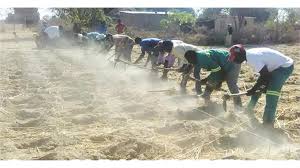
Against all the damaging statistics, the government initiated the Pfumvunza/Gatshompo farming scheme, as a programme to achieve food security and improve yields in the wake of climate change.
The scheme requires farmers to plant no later than November 25 in straight lines, with thick mulch cover in weed free fields and correct application of inputs in each hole.
The mulch is to retain moisture and the hole planting is to ensure that fertilizer is not wasted.
Under the Pfumvunza scheme, the government is targeting 1, 8 million rural households to produce 1, 8 million metric tonnes of cereal crops as well as 360 000 metric tonnes of oilseed.
Also, the government set a target of 1.5 million hectares under maize, with an expected yield of 2.4 tonnes per hectare.
The government tasked each of the country’s rural provinces to average 225 000 tonnes of cereal and 45 000 tonnes of oil seed at one tonne of grain and 200Kg of oil seed from the average small scale farming household.
While the scheme appears noble and well thought out the main question that serious agricultural experts should noise about, is that will the programme manage to increase yield and mainstream food security?
To start with, we have different farming regions receiving varying amount of rainfalls. In drought prone rural provinces such as Matabeleland North rainfall might arrive later than November 25 or in small quantities.
Much more, different areas require specific seeds that can grow in the respective climate. Will the government appreciate that or it will distribute inputs without tacking this into cognizance.
More importantly, Gatshompo scheme is set to rely largely on rain fed farming. While the mulch idea is noble what happens when there are longer dry spells during the farming season.
For instance rain might fall in November and disappear only to re-appear in February next year. Will farmers continue to water plants like garden farming? Gardening faming is for small production and we cannot talk about food security.
In some areas such as Cross Mabale in Dete, Hwange district, there are no dams and the water table is too depleted and thus making it next to impossible to install boreholes. Therefore, where will they get water?
In 2020, can the country still rely on rain fed agriculture to achieve bumper harvests and ensure food security?
In earnest, the long term answer is that the government should build more dams and irrigation schemes so that farmers have a predictable and reliable source of water.
Naturally, dams harvest water and improve the water table and this gives farmers a decent access to water for farming.
Also, in terms of grains, the government should provide specific seeds suited for a given area. In that way it would have tackled droughts induced by climate change.
Suffice to say, education is key in changing people’s mentality and a lot of villagers are not aware as to why the government initiated the Gatshompo scheme. With sufficient knowledge villagers can increase their efforts to adapt to smart climate change farming.
Otherwise as things stands we are likely to have food shortages next year because the farming methods implemented by government have come short of smart climate change agriculture.


