



MUSA MAKINA
DRIVING to Sifulasengwe from Tsholotsho Centre almost 100 kilometers, is no task for the feeble. The rugged, meandering and bumpy dust road is also not for low clearance vehicles.
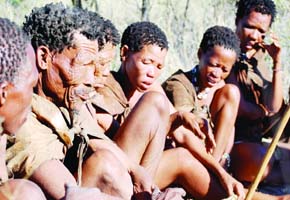
But this is the route to the remaining population of the nomadic Tshwao community, popularly known as the San or Amasili in Ndebele-a people- marginalised for years, and their lives reconfigured in a pre and post independent Zimbabwe.
Historically known for their undying penchant for hunting and gathering, the government has criminalised hunting of wild animals forcing them to adjust to new lives.
A recent visit to Mpilo village under Chief Siphoso in Tsholotsho District which shares the boundary with the Hwange National Park, unearthed an untold life of the San people.
While many thought their nomadic culture is now a thing of the past, the San cannot easily let go of their past -it’s in their DNA.
An investigation by The Zambezi Times revealed that while they have to some extent adopted some modern lifestyles such as wearing clothes and framing for a living, their nomadic life of hunting and gathering and temporary shelter construction is still part of their daily lives.
The tour revealed that after every rainy season, the San community drifts some 20 to 50 kilometres deep into the densely populated bushes harbouring dangerous animals like lions and elephants, just at the foot of the Hwange National Park in Sifulasengwe.
Here they set up several temporary makeshift homes they call Emlageni in vernacular.
In these camps, children male adults and females are all allocated different duties. Young boys are tasked to look after the cattle to protect them against the marauding lions and hyenas in the forest.
Women are usually tasked with harvesting grass for resale while men do the overall supervisory duty.
Back to places they call real homes, the structures are just an eyesore, with some of them without doors and in bad shape. Someone in a normal rural set up, would easily dismiss the houses built on poles and dagga as unfit for human habitation. But that is what the San in this area are grappling with.
A further inquiry revealed that during their stay in the bush, they also feast on wild animals, a development that has created a bad blood between them and the National Park rangers, who often trace their spoors all the way from the giant park back to Emlageni.
“Life is difficult here, we don’t have any form of income, after every rain season we travel from our homes to try and harvest some grass for resale, it’s on demand,” says Jesta Ndlovu.
“The buyers don’t bring money, they usually bring clothes, groceries and other goodies in exchange for grass, that has been our lives for years.”
Coming across the young boys herding cattle, clad in shorts only without any tops, they quickly disappear in the thick bushes, a clear sign that they are not used to visitors.
Upon approaching another makeshift, a group of vicious dogs numbering about 11 charged at the visitors only to be restrained by Mpilo village head Mthandazo Vundla who had accompanied the news crew all the way to the temporary camps.
“This is my security fence. My dogs can sniff anything from a distance and I can tell what type of animal it is. If it’s a lion, you can tell that it’s another cat, if it’s an elephant, I can tell by their reaction,” says Robson Ndlovu.
“However, we experience a number of cattle attacks by hyenas and lions mostly, like now I have two which were attacked so I have quarantined them to another kraal where I am closely monitoring and treating them.”
Surprisingly, the makeshift homes are so far apart in the dense forest and the courage is so amazing.
“I sleep here alone guarding my cattle and my dogs are always here to protect me and my herd. So if elephants are coming close I burn a certain concoction to ward them off. I am safe, I fear nothing,” he said.
He however denied that they are into wildlife poaching.
“Yes the rangers are giving us a torrid time here because they think we are busy killing animals in the park but we don’t do that because it’s a crime. They persecute us on several occasions,” he said.
Village head Mthandazo Vundla said it is unusual that San community members migrate to greener pastures every year.
“If you check here after the rainy season we experience dry periods hence grazing pastures will be scarce so those with cattle they go deep in forests where they camp until the next rain season. If they don’t do that their cattle will die,” he said.
“It is also an opportunity for women to have a lot of products that are found in the forest so that they can sustain themselves. Most of us here are not into farming, we only do small scale farming and we don’t realise much.
“Besides our mode of farming is different, some of us do not own any cattle so we rely on having an ox drawn plough being pulled by us. That’s how we do it,” Vundla said.
In a positive move, government recently deployed a delegation to assess the situation in the San community. In its feedback to the Cabinet in July the delegation indicated that the San people lack birth certificates and identity documents and encounter high teenage pregnancies.
It was also revealed that there are very low school completion rates at primary and secondary school. Food insecurity mainly due to human-wildlife conflict and failure to practice modern agriculture were other challenges facing the San.
As a result, the government resolved to attend to the concerns with immediate effect.
Vundla however said he was happy that government acknowledges the structures marginalization of the San.
“We are praying things will change for us, because we have for years been treated like we do not exist. We lag behind on everything. We just hope action will be taken sooner than later,” said Vundla as he urged caution.
As part of the directive by government every ministry was ordered to identify and take up a developmental role in areas inhabited by the San/Tjwao communities and that two or three primary and an equal number of secondary schools be set up as boarding institutions in areas easily accessible to them.
It was also resolved that proceeds from the Campfire programme be ploughed back to benefit communities living in areas where there is abundant wildlife.
Security ministries were also ordered to waive the entry requirements to enable San/Tjwao citizens to enlist into the respective uniformed services.


